

Key Takeaways
- Convergence insufficiency happens when your eyes struggle to work together up close.
- Lazy eye means one eye sees less clearly than the other.
- A standard 20/20 eye chart test often misses convergence problems.
- Both conditions fall under binocular vision troubles and can affect reading, work, and school.
- Vision therapy can help train focusing and eye alignment over time.
What Convergence Insufficiency & Lazy Eye Mean
Maybe you sit down to read, but it only takes a few minutes for the words to swim or double on the page. Or maybe your child avoids homework or rubs their eyes during class. These moments can point to two different kinds of vision problems that our team at Ottawa Vision Therapy can help you sort out.
Convergence insufficiency means your eyes have trouble turning inward to work together on close tasks. On the other hand, lazy eye means that one eye sends a weaker, blurrier signal to your brain. Both conditions involve the way that your eyes and brain team up, so they’re easy to confuse without a professional assessment.
Key Differences Between the Two Conditions
How Each One Affects Your Eyes
With convergence insufficiency, one eye tends to drift outward when you look at something near, like a book or phone. Your brain then works overtime to pull the image back together.
With lazy eye, one eye sees less clearly, even when you wear glasses. This happens because the connection between that eye and the brain never fully developed.
Both of these conditions are forms of binocular vision trouble, which is part of why they share some symptoms. .
Why Convergence Problems Get Overlooked
A standard eye chart checks how clearly you see letters from across the room. You can read every line and still have trouble getting your eyes to team up at reading distance.
Symptoms of binocular vision problems also come and go. You might feel fine some days, which makes the problem easy to brush off.
Signs and Symptoms to Watch For
Signs of Convergence Insufficiency
These symptoms often show up during reading, screen time, or other close work.
- Double or blurry vision when you read
- Headaches, eye strain, and trouble concentrating
- Squinting or closing one eye to see better
Signs of Lazy Eye
Lazy eye tends to affect one eye more than the other, so the clues may look a little different. Pay attention to
- Poor depth perception, like misjudging steps or catching a ball
- Blurry vision in one eye
- Trouble with reading or tasks that need steady focus
How Ottawa Vision Therapy Diagnoses Each Condition
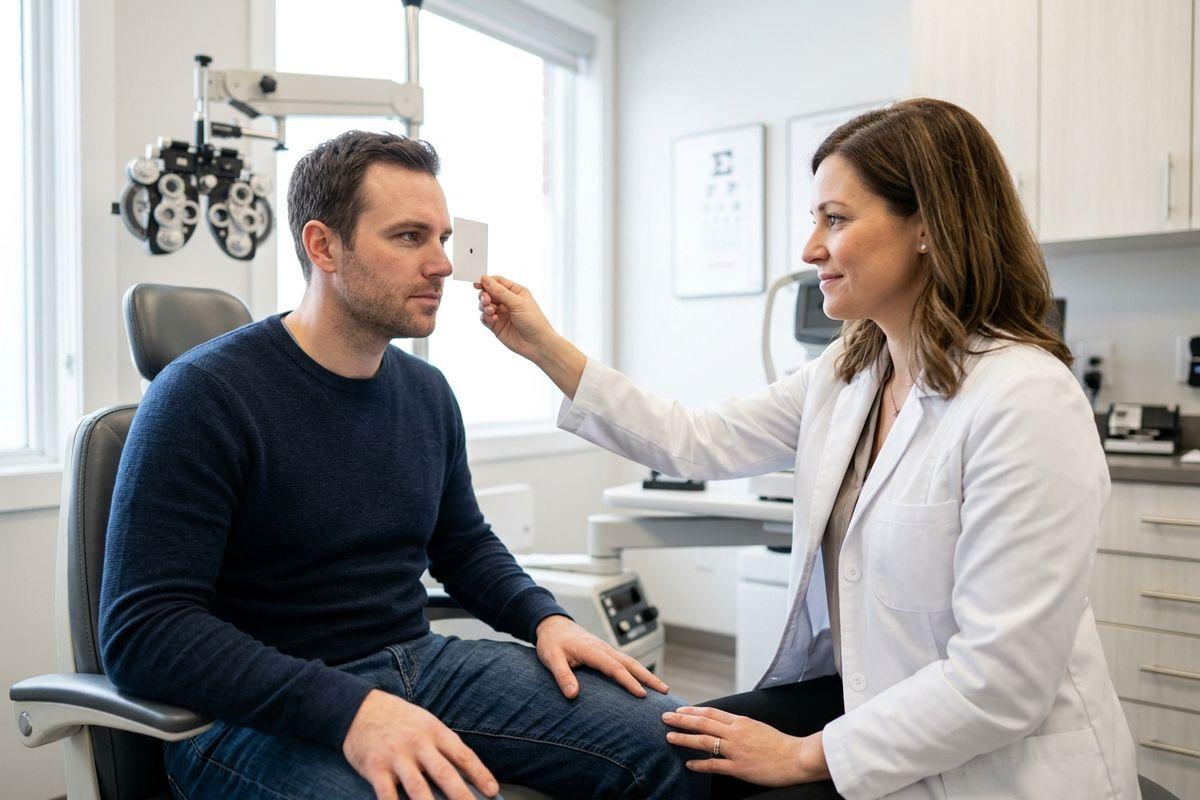
To identify convergence therapy, our team measures your near point of convergence. This shows how close an object can come to your nose before your eyes stop working together.
Next comes a cover test, where your eye doctor covers and uncovers each eye to watch how they align and team up. From there, a full binocular vision assessment ties everything together. This helps our optometrists in Ottawa see how your eyes focus, move, and coordinate.
Treatment Options & What Can Make Symptoms Worse
Vision Therapy & Tools
Vision therapy uses targeted eye exercises to train focusing and alignment. Over weeks of practice, your eyes learn to work together with less effort.
Depending on your situation, we may also use prisms, lenses, and computer-based training to support your progress. Each of our plans is tailored to one patient, whether that’s a child struggling in school or an adult working through lingering concussion symptoms.
Take the Next Step for Your Vision
If you’re struggling with binocular vision problems, our team at Ottawa Vision Therapy can assess what’s going on and build a plan around your goals. Book an appointment today and let us help you see comfortably.