

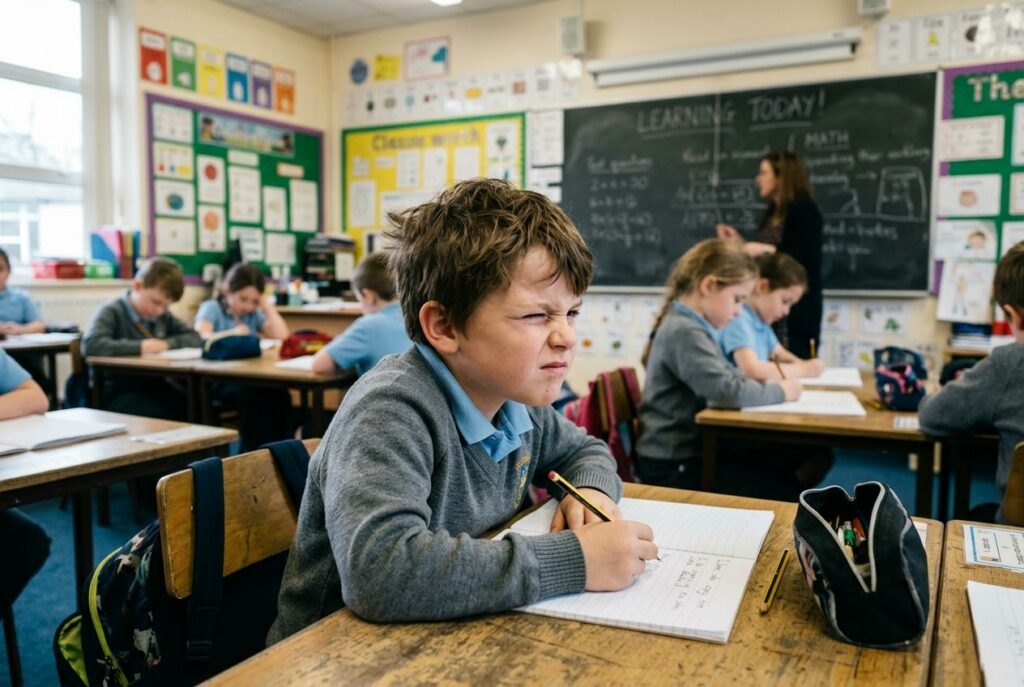
Your child is bright, curious, and trying hard at school, but something still feels off. Grades aren’t where they should be, homework takes forever, and your child seems frustrated more often than not. Before assuming it’s a focus or behavioural issue, it’s worth considering something many parents overlook: could vision be playing a role? Our team at Ottawa Vision Therapy sees this pattern regularly, and the connection between visual skills and classroom performance is stronger than most parents realize.
Poor vision can quietly hold children back in the classroom, affecting everything from reading and writing to how they connect with classmates and teachers. The good news is that once the visual challenges are identified, targeted support through a personalized vision therapy program can help your child get back on track.
1. Trouble Focusing and Staying on Task
When your child’s eyes struggle to focus clearly, staying locked in on a lesson takes enormous effort. Instead of absorbing what the teacher is saying, your child’s brain is working overtime just to make sense of what it’s seeing. That mental load adds up fast, and attention starts to slip.
A short attention span isn’t always about behaviour. Visual strain can make it genuinely exhausting to sit through a full school day. Children often can’t explain why they feel worn out; they just know that school feels hard in a way they can’t put into words. If you’re wondering whether vision therapy could help, this overview of visual skill issues can give you a clearer picture of what to look for.
2. Lower Reading and Comprehension Skills
What This Looks Like in the Classroom
Your child might read slowly, skip lines, or frequently lose their place on the page. While classmates move ahead in reading groups, your child falls behind, not because they aren’t capable, but because the words on the page aren’t staying still or staying clear.
You might notice your child re-reading the same sentence several times without seeming to take it in. That’s not a sign of laziness. It’s often a sign that their visual system is working against them.
How Visual Skills Tie Into Reading
Reading requires the eyes to track smoothly from word to word across a line of text. When eye tracking is off, that smooth flow breaks down, and comprehension suffers along with it. Your child may understand a story perfectly when it’s read aloud, but struggle to get the same meaning from the page on their own.
Focusing ability matters just as much. If your child’s eyes can’t hold focus long enough to get through a paragraph, the meaning gets lost. A thorough vision assessment from a qualified optometrist in Ottawa can help identify exactly where that breakdown is happening. Vision therapy for reading difficulties targets these exact skills with exercises built around your child’s needs.
3. Weak Hand-Eye Coordination
Vision and movement are closely connected. When your child’s visual system isn’t working well, tasks that require the hands and eyes to work together, like writing, drawing, or cutting, can feel frustrating and clumsy. Schoolwork that other kids breeze through takes much longer and feels much harder.
This challenge also shows up outside the classroom. Sports, playground games, and gym class all depend on hand-eye coordination. When your child struggles to track a ball or time their movements, it can affect their confidence in group activities and make recess feel less enjoyable. The connection between the brain and eyes plays a big role in how well these skills develop.

4. Social and Communication Challenges
Missing Visual Social Cues
A lot of communication happens through facial expressions and body language, and children rely on these cues to understand what’s going on around them. When vision is blurry or uncoordinated, your child may miss a teacher’s look of encouragement or a classmate’s smile from across the room.
Over time, missing these small moments can make it harder for your child to build connections and feel like they belong in the classroom. It’s a side of vision problems that often goes unnoticed by parents and teachers alike.
Frustration and Behavioural Changes
When school feels hard every single day, children respond in different ways. Some act out, some withdraw, and some simply stop trying. These behaviours are often misread as attitude problems when they’re actually a response to unaddressed visual discomfort.
Low self-esteem can quietly build up over months and years when a child feels like they can’t keep up. Addressing the visual root of the problem can change that pattern in a meaningful way. Vision therapy works through neuroplasticity, helping retrain the visual system rather than simply correcting what the eye can see.
Signs Your Child May Have a Vision Problem
Some signs are easy to spot, while others are easy to dismiss as habits or quirks. Here’s what to keep an eye on:
- Squinting, rubbing their eyes, or tilting their head to see better
- Sitting unusually close to the TV, tablet, or classroom board
- Frequent headaches, especially after reading or screen time
- Avoiding books or homework without a clear reason
- Losing their place while reading or using a finger to track words
Next Steps After Noticing These Signs
A school vision screening checks basic clarity, but it doesn’t catch many of the visual skill issues that affect learning. Comprehensive eye exams go much deeper than a basic screening, and a full assessment from an experienced Merivale optometrist looks at how the eyes focus, move, and work together as a team.
If a visual skill gap is identified, vision therapy can target it directly with a personalized program tailored to your child’s specific needs.
We Can Help
Our team at Ottawa Vision Therapy works with children to assess, address, and support their visual development so that school can feel a little less like a struggle and a little more like a place where they can thrive. Book an appointment today and take that first step toward giving your child the visual tools they need to learn comfortably and confidently.